
Parts of the canoe click on photo for expanded view and on part name to return to previous page
Kupe: ʻO ke kupe ka uhi lāʻau e pale ai i ka ihu a me ka hope o ka waʻa i nā nalu e hele mai ana. Ma mua o ka hiki ʻana mai o nā mea kālai hao, hana ʻia ke kupe i ʻelua māhele, a humuhumu ʻia lāua me nā kaula. Ma hope o ka launa ʻana me ka poʻe Komohana, ua hoʻomaka ʻia ke kupe e kālai ʻia i hoʻokahi māhele.

ʻO ke Palekai he ʻāpana mua nō ia o ke Kuapoʻi, a ʻo kāna hana, he pale nalu, i mea e pale aku ai i ke kahe ʻana o ke kai ma luna o ke kupe, a i ʻole ke pāholo ʻana o ka waʻa i ka wai. Ma mua o ka launa ʻana me ka poʻe Komohana, he paia lōʻihi ke Palekai, a ua kau ʻia kūʻē pololei ia i ka waha o ka waʻa.
Ma hope o ka launa ʻana me ka poʻe Komohana a me ka laha ʻana o nā mea hana hao, ua hoʻomaka ʻia ke kupe e kālai ʻia i hoʻokahi māhele, a ua nalowale ka hana kūʻokoʻa ʻana o ke Kuapoʻi, a lilo aʻe ia i ʻāpana o ke kupe kahi e kau ai ke Palekai. Ma ia wā, ua kālai ʻia ke Palekai me ke ʻano V, me ka piko e kuhikuhi ana i mua.

Kuapo'i The Kuapo'i was some times called the Kaupo'i and was a triangular hatch plate that fit into the back portion of the kupe onto which the Palekai was attached or built into. When the Kupe began to be made in one piece, the Kuapo'i lost its seperate construction and beame the portion of the Kupe upon which the Palekai rests.

Po'opāo'o The Po'opāo'o refers to the upper most point of the manu. The shape of the Po'opāo'o varied from district to districtt. In some areas the Po'opāo'o was dimond shaped while in others it was very rounded. In some canoes it was very broad while in others it was thin and sharp.

Maha : Maha is defined as the temple of the forehead and in the case of the Kupe it referred to the concaved shaped area of the kupe where the Manu flows into the 'Ēkū..

'Ēkū; The 'ēkū was the portion of the Kupe that was attached to the the upper edge of the canoe hull or Ka'ele. It extened back from the forward Kupe and and forward of the stern Kupe to where it attached to the Mo'o or gunwale
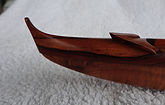
Auwae: Auwae literally means chin. It is used to describe the joint where the 'ēkū meets the mo'o.

Manu: Manu literally means bird. It is used to the describe the up turned end of the Kupe. This Manu is the most conspicuous difference between Hawaiian canoes and other Polynesian canoes. In modern times Manu is used to refer to the whole bow cover or Kupe. Traditionally Manu only refered to the up turned end of the Kupe..

Kua'iako: Kua'iako refers to the portion of the 'iako that is within the hull of the canoe and directly above the Wae. It literally means the back of the 'iako..

Muku Muku literally means to cut short. It refers to the starboard end of the 'iako that extends beyond the edge of the gunwale..

Lapu'una : Lapu'una literally means a hump or arch. In the case of the 'iako, the lapu'una refers to the section of the 'iako that extends out from the hull of the canoe and gently arches upward before turning back down to where it is attached to the ama. This moderate arching raises the 'iako just enough so as to be above oncoming swells that pass between the Ama and the Ka'ele

Kapua'i .Literally means the sole of the foot and refers to the end of the 'iako that is lashed to the ama. .

Ama: The ama is the float for the outrigger canoe and also refers to the starboard hull of a double canoe because it replaces the outrigger float.. Traditionally the ama was almost always placed on the left side of the canoe hull.

Lupe: Lupe literally means Kite and also is the term for Stingrays. Lupe in this context also applies to the "Cut Water" section of the front of the Ama. The Lupe is distinctly Hawaiian and not found on any other Pacific Canoes.

Puali: Puali refers to Hawaiian Warriors because the warriors would fold (Puali) their Malo (loin cloth) tightly so it could not be grabed by an enemy while in battle.. In the case of the canoe it is used to describe the leading edge of the Lupe section of the ama where the Lupe is cut with a lightly concave edge at the front of the ama.

Umauma: Umauma means chest or breast and refers to the front section of the ama that rises up out of the water.

Mo'o: refers to the side planks or gunwales set on the top of the canoe hull. This removable plank not only extended the free board of the canoe but also protected the upper edge of the canoe hull (Nīao) from ware and tear caused by fish lines, nets and paddles rubbing up against it. Mo'o also refers to any lizard, dragon, water spirit of any kind..

Nīao: . Nīao refers to the upper edge of the canoe hull to which the mo'o or gunwale was attached.

Ōpūhue:. Ōpūhue literally refers to a round low calabash. The lower section of the Ka'ele (hull) would bulge out like a calabash. This bulging out allows the canoe to carry more weight and allows the canoe ride higher in the water. While this hull shape reduces tracking ability it enhances the canoe's ability to travel in rough sea conditions.

Pepeiau: Pepeiau translates into "ear". Pepeiau are cleats carved out of the side of the canoe hull forming a small shelf upon which the seat (Nohoana) are attached.
